
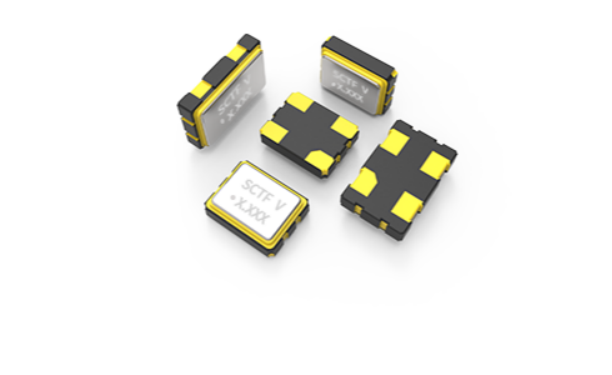
The concept of voltage-controlled oscillator
A Voltage-Controlled Crystal Oscillator (VCXO) is a quartz crystal oscillator whose output frequency can be adjusted by an external control voltage. In typical VCXO applications, the frequency is "pulled" by varying the capacitance of a varactor diode via the control voltage. VCXOs offer a relatively wide tuning range, typically ≥±100 ppm.
Key Electrical Parameters:
1. Nominal Frequency
One of the most critical parameters of an oscillator. Frequency represents the number of oscillations per unit time, usually expressed in MHz.
2. Operating Voltage
The voltage range within which the oscillator functions normally. Outside this range, frequency stability may degrade, or the oscillator may fail. Expressed in [V].
3. Package (Holder Type)
he physical size of the oscillator. Common SMD packages include 3225, 5032, and 7050.
4. Total Frequency Deviation (Frequency Stability)
Includes frequency variations due to temperature, voltage changes, and aging (measured at Vc = 1.65V ±0.1V). Expressed in [ppm], this parameter is critical for high-precision applications like communications and navigation.
5. Current Consumption
The current drawn by the oscillator under specified operating conditions. A key parameter for power-sensitive applications. Expressed in [mA].
6. Output Waveform
Common output types include CMOS square wave, LVPECL, LVDS, HCSL, and CML.
7. Output Load Condition
The load-driving capability of the oscillator. Expressed in [pF].
8. Operating Temperature Range
The temperature range for normal operation, typically -40°C to +85°C, -40°C to +105°C, or -40°C to +125°C.
9. Storage Temperature Range
The safe storage temperature range when the oscillator is not in use, usually -55°C to +125°C.
10. Duty Cycle
The ratio of high/low levels within one cycle. Expressed in [%].
11. Rise/Fall Time
The time required for the output signal to transition between 10% and 90% of VDD. Expressed in [ns].
12. Pulling Range
The frequency deviation range achievable by applying an external control voltage (1.65V ±1.35V). Expressed in [ppm].
13. Absolute Pulling Range (APR)
APR = Pulling RangeFrequency StabilityAging Rate. Expressed in [ppm].
14. Center Voltage (Control Voltage)
The nominal control voltage, typically 1.65V (half of the operating voltage).
15. Control Voltage Range
The allowable range for the control voltage, typically 1.65V ±1.35V.
16. Linearity
The ratio of adjustable frequency deviation to total deviation (max 10%). Expressed in [%].
17. Modulation Bandwidth
Minimum 15 kHz.
18. VC Input Impedance
Minimum 5 MΩ.
19. Aging Rate
The long-term frequency drift caused by gradual changes in the crystal and circuit components. Expressed as daily aging (ppb/day) or annual aging (ppm/year).


